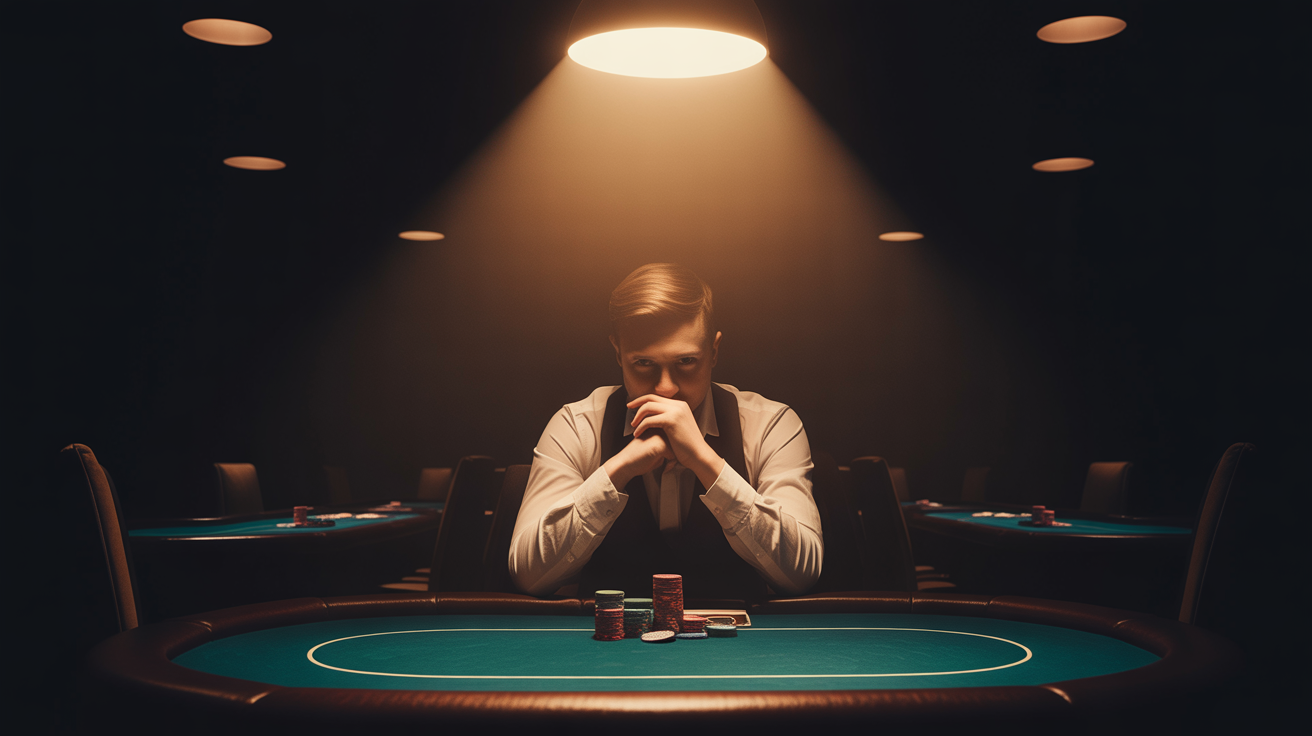
Reading Micro-Expressions at the Poker Table
Micro-expressions last just 1/25th of a second—but they reveal everything. Here's how to catch them at the table.
Reading Micro-Expressions at the Poker Table
The river card hits the felt. Your opponent pauses, then fires a pot-sized bet. Your hand is strong—top two pair—but something flickers across their face before the chips leave their stack. A tightening around the eyes. A barely perceptible compression of the lips. Gone in less than a tenth of a second.
That flash of involuntary expression just told you everything you need to know.
Micro-expressions are the body's most honest language. They bypass conscious control, surfacing before the rational mind can suppress them. At the poker table, where deception is currency, learning to read these signals is the difference between a hero call and a costly fold.
What Are Micro-Expressions?
Micro-expressions are brief, involuntary facial movements that last between 1/25th and 1/5th of a second. First documented by psychologist Paul Ekman, they represent the leakage of genuine emotion when a person is attempting to conceal how they feel.
Unlike deliberate expressions—the practiced poker face, the theatrical sigh—micro-expressions cannot be faked or suppressed with any reliability. They are hardwired into the human nervous system, tied to the seven universal emotions: happiness, sadness, fear, disgust, contempt, anger, and surprise.
At the poker table, the emotions most relevant to your reads are:
- ♠Fear — the involuntary signal of a bluff under pressure
- ♠Contempt — the asymmetric lip curl that often accompanies a monster hand
- ♠Surprise — the brief widening of eyes when a card hits that changes everything
- ♠Disgust — a subtle nose wrinkle when an opponent is forced into a difficult spot
Understanding which emotion maps to which situation is the foundation of live poker reads.
The Baseline Problem: Why Most Players Read Tells Wrong
Before you can identify a deviation, you need to know what normal looks like.
This is where most amateur tell-readers fail. They see a player scratch their nose and immediately assign meaning to it. But without a behavioral baseline—a clear picture of how that player acts when they are not under pressure—any single gesture is meaningless noise.
Establishing a baseline requires observation across multiple streets and hands. Watch your target when they are not in a pot. How do they hold their posture? Where do they look when they fold? How do they handle their chips when relaxed?
Once you have that baseline locked in, deviations become visible. A player who normally maintains steady eye contact but suddenly averts their gaze on the river is showing you something. A player who typically sits upright but slumps slightly after calling a 3-bet is leaking information.
The baseline is your calibration tool. Without it, you are guessing.
High-Stakes Moments: When Micro-Expressions Are Most Visible
Micro-expressions surface most reliably at moments of peak cognitive load—when your opponent's brain is managing both decision-making and emotional concealment simultaneously.
These moments include:
- ♠The instant a community card is revealed — Watch the face in the half-second before the player looks away from the board. This is when genuine surprise or satisfaction leaks through.
- ♠The moment they look at their hole cards — Most players have trained themselves to maintain a neutral expression here, but the very first glance often produces a micro-expression before the mask goes up.
- ♠When facing a large bet or raise — Cognitive load spikes when a player must calculate pot odds, assess their range, and manage their emotional response. This is prime leakage territory.
- ♠After making a bluff — The moment chips are committed, many players experience a brief flash of fear or relief. Watch the face immediately after the bet lands.
Practical Drill: The Two-Second Window
After each significant action—a big bet, a raise, a call on a scary board—focus on your opponent's face for exactly two seconds. Do not look at the chips. Do not look at the board. Watch the face.
That two-second window is where the truth lives.
Specific Micro-Expressions and What They Signal
The Contempt Asymmetry
Contempt is the only universal emotion that appears asymmetrically on the face—a slight raising and tightening of one corner of the mouth. In everyday life, it signals superiority or disdain. At the poker table, it often surfaces when a player holds a hand they consider dominant.
Scenario: You open from the cutoff with A♠K♦. The button 3-bets. As you consider your options, you catch a brief asymmetric lip raise on the right side of their face. They have a hand they feel superior about—likely QQ, KK, or AA. Folding AK here is not weakness; it is precision.
Fear Micro-Expressions
Fear manifests as a brief widening of the eyes, a slight raising of the upper eyelids, and a horizontal stretching of the lips. It is the expression most associated with bluffing under pressure.
Scenario: You are on the river with a missed flush draw and fire a large bluff. Your opponent pauses, and in the moment before they act, you catch a flash of widened eyes and stretched lips. They are afraid—considering folding. Maintain your composure. Any behavioral shift from you now could undo the work the bluff has already done.
Surprise and the Board Texture Tell
When a community card significantly improves a player's hand, the brain registers surprise before the conscious mind can suppress it. This manifests as a brief raising of the eyebrows and widening of the eyes—lasting less than a quarter of a second.
Scenario: The turn brings the 7♣, completing a potential straight. You watch your opponent's face as the card is revealed. A micro-flash of raised brows and widened eyes. They just connected. Proceed with extreme caution.

Managing Your Own Micro-Expressions
Reading opponents is only half the equation. The other half is ensuring you are not broadcasting your own emotional state.
The challenge is that micro-expressions cannot be suppressed through willpower alone—the expression fires before the conscious command can intercept it.
The most effective countermeasure is emotional neutralization, not suppression. Train yourself to genuinely not react emotionally to cards. This requires deliberate practice:
- ♠Visualization drills: Before sessions, mentally rehearse receiving premium hands and complete air. Practice maintaining the same internal emotional state for both.
- ♠Breathing regulation: A controlled breathing pattern—four counts in, four counts out—reduces the physiological arousal that triggers micro-expressions.
- ♠Focal point discipline: Choose a fixed focal point when looking at your hole cards. A consistent, mechanical process reduces the emotional spike that causes leakage.
For a comprehensive framework on controlling your own tells while reading others, The Face Doesn't Lie by Faceless Champ provides a systematic approach to both sides of the psychological equation. [Internal link: https://www.amazon.com/dp/B0GR1JGRLP?binding=kindle_edition&ref_=dbs_s_ks_series_rwt_tkin&qid=1773233195&sr=1-2]
Integrating Reads Into Your Decision-Making
A micro-expression read should never be the sole basis for a major decision. It is one data point in a larger framework that includes:
- ♠Range analysis — What hands does this player's betting pattern represent?
- ♠Board texture — How does the runout interact with their likely range?
- ♠Bet sizing tells — Does the size of their bet align with their range, or suggest polarization?
- ♠Behavioral history — Have you seen this player make similar moves before?
When a micro-expression read aligns with your range analysis and board texture assessment, your confidence should increase significantly. When it conflicts, treat it as a flag for further observation rather than a definitive signal.
The goal is not to become a human lie detector—it is to add a layer of precision to decisions that are already well-reasoned.
Building Your Observation Practice
Elite live players do not wait until they are in a hand to gather information. They observe constantly—cataloging behavioral baselines, noting deviations, building psychological profiles of every player at the table.
Start with one target per session. Choose the player you are most likely to face in significant pots and dedicate your off-hand attention to observing them. Note their baseline posture, chip-handling habits, and eye movement patterns. By the time you are in a major pot with them, you will have a rich behavioral profile to draw from.
As your skills develop, expand your focus to two or three players simultaneously. Over time, this becomes automatic—a background process running while your conscious attention manages your own decisions.
The players who consistently make the right call in ambiguous spots are not guessing. They have been reading the room since the first hand was dealt.
Final Thoughts
Micro-expressions are not magic. They are science—involuntary neurological responses that surface when the emotional brain outpaces the rational one. At the poker table, where every player is working to conceal their true state, these flashes of genuine emotion are among the most reliable signals available to you.
The discipline required to read them consistently is significant. It demands patience, systematic observation, and the willingness to invest attention in hands you are not playing. But the edge it creates—the ability to make precise decisions in spots where other players are operating on incomplete information—is one of the most durable advantages in live poker.
The face doesn't lie. Start listening.
Faceless Champ
Poker psychology, behavioral strategy, and the hidden signals players reveal under pressure.